Switching to induction instantly trims cooking times, safeguards indoor air, and lowers energy bills, all without stretching your budget.
This guide delivers every practical detail you need to choose, install, and maintain an affordable induction cooktop that serves kitchens worldwide.
How Induction Technology Works
Induction relies on electromagnetic currents passing through hidden copper coils to generate heat directly inside compatible cookware.
Because the pan itself becomes the heat source, temperature shifts happen in seconds, not minutes, which means you gain precise control and faster results compared with both gas and conventional electric surfaces.
The smooth glass-ceramic top remains relatively cool during use, reducing burn risks and making post-meal cleanup straightforward.
Five Advantages That Make the Switch Worthwhile
Frustrated by uneven flames and stubborn stains? Therefore, consider the benefits that induction offers over gas or radiant electric stoves:
- Rapid heating and cooling: Water can reach a rolling boil in roughly three minutes, while power reductions register almost instantly, enabling perfect simmers.
- Built-in safety features: Elements activate only when magnetic cookware touches the zone, and the surrounding surface stays cooler, lowering accidental burn potential.
- Superior energy efficiency: Up to fifteen percent less electricity than standard electric coils and nearly triple the efficiency of gas burners keep utility costs in check worldwide.
- Cleaner indoor air: No open flame means zero combustion by-products such as carbon monoxide or benzene, preserving household air quality.
- Effortless maintenance: The flat surface lacks crevices, so most spills wipe away with a damp cloth before residues can bake on.
Matching Cookware to Magnetic Requirements
Gas woks may thrive on curved steel, yet induction demands firm, magnetic contact for reliable performance, which means you must verify pan compatibility before purchase.
- Ideal materials: Cast iron, enamelled cast iron, carbon steel, and stainless-steel alloys containing iron.
- Quick magnet test: Press a fridge magnet against the pan base; a secure hold confirms suitability.
- Flat bottoms matter: Traditional round-bottom woks struggle unless your cooktop includes a recessed wok zone; opt for a flat-bottom induction wok instead.
Understanding Power, Wattage, and Circuit Capacity
Measure amperage before falling for marketing specs, as a result, you avoid expensive electrical surprises after checkout.
- Element wattage: Standard zones deliver 1,600–3,000 W, while “boost” modes can exceed 4,000 W by borrowing power from neighboring zones for rapid searing or quick boils.
- Circuit requirements: Many full-size models draw more than 15 amps, so they must be hard-wired to a dedicated 20- to 40-amp circuit. Engage a licensed electrician to confirm panel capacity and run new cabling if necessary.
- Visible dimming: When boost diverts current, adjacent zones may pulse slightly, an expected behavior rather than a fault.
Sizing the Cooktop for Your Benchtop
Small apartment or expansive island, every bench worldwide follows similar depth conventions, which means accurate measurements prevent costly returns.
| Common Edge-to-Edge Width | Typical Depth | Elements |
| 30 cm (compact) | 50–52 cm | 2–3 |
| 60 cm (standard square) | 50–53 cm | 4 |
| 90 cm (family-size) | 50–53 cm | 5 |
Before ordering, record the cut-out dimensions beneath your existing unit. Manufacturers publish minimum clearance diagrams in their manuals; comparing those figures to your cabinetry ensures a flush, professional fit.
Installation and Ventilation Checklist
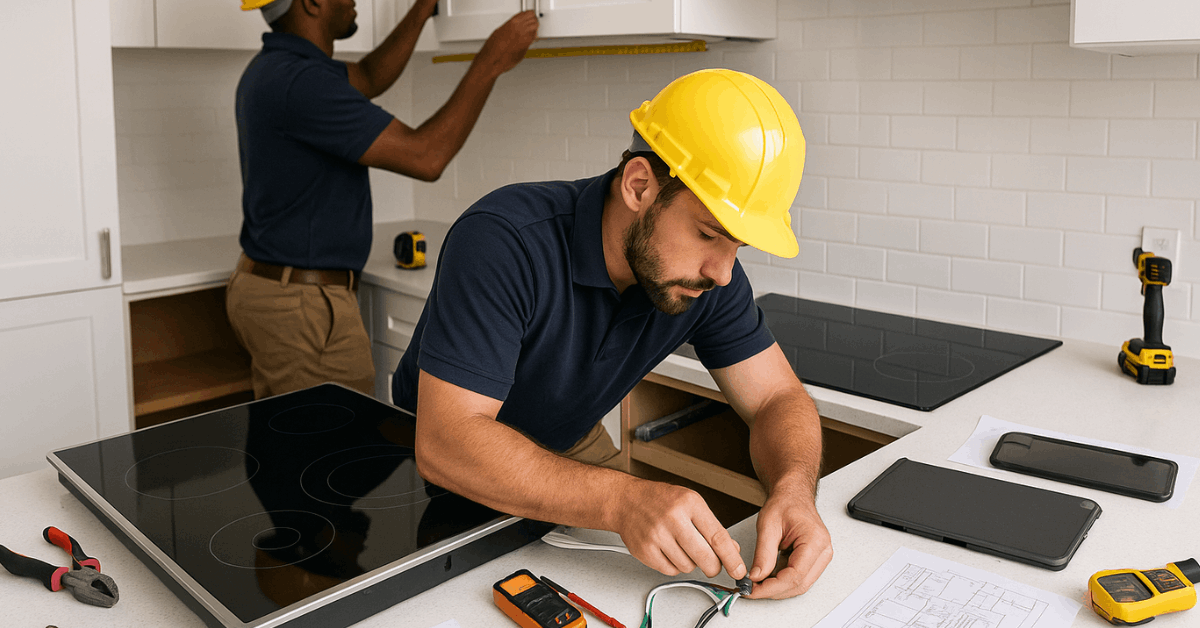
Rushing into DIY wiring can jeopardize appliance warranties; in turn, coordinate the following steps with qualified trades:
- Decommission gas safely: Hire a licensed gasfitter to cap and pressure-test the old gas line.
- Confirm electrical load: An electrician assesses panel amperage, installs a dedicated circuit, and hard-wires the cooktop.
- Plan ventilation early: Even though induction releases no combustion gases, steam and grease still require extraction. Aim for a 400–600 CFM rangehood, or choose a cooktop with integrated downdraft if overhead clearance is limited.
- Schedule simultaneous tasks: Pair cooktop installation with rangehood fitting to minimize labor callouts.
Purchase and Setup Costs
Sticker prices start near US $600 and climb beyond US $6,000, yet savvy shoppers worldwide can secure reliable models in the US $1,000–US $2,000 range. Factor these additional expenses:
- Electrical labor and materials: US $600–US $1,200 for a new circuit or panel upgrade.
- Gas line capping: US $250–US $500 where applicable.
- Downdraft ducting or hood installation: US $300–US $900 depending on run length and roof penetration.
Request multiple quotes, verify licenses, and confirm workmanship warranties before authorizing work.
Warranty and Consumer Protection
An induction cooktop is a multiyear investment, which means robust coverage matters. Aim for:
- Minimum two-year parts and labor warranty: Many manufacturers meet this baseline, while premium brands extend to five years or longer.
- Surface glass guarantee: Look for separate coverage on the glass-ceramic top against cracks or discoloration.
- Clear major-failure clauses: Policies should compensate for reasonable consequential losses if the appliance proves unrepairable.
- Local service network: Confirm accessible authorized technicians before purchasing, especially when selecting lower-priced overseas brands.
Simple Care Routines for Longevity
Scratched glass and burnt residues shorten service life; that way, consistent habits keep the surface pristine:
- Lift, never slide, heavy pans across zones.
- Wipe spills promptly with a soft cloth and mild detergent.
- Avoid abrasive scourers; instead, use manufacturer-approved glass scrapers for hardened sugar or plastic.
- Never chop or rest grocery bags on the cooktop, since concentrated force can fracture the glass.
Do You Need Three-Phase Power?
Large houses stuffed with high-draw appliances occasionally exceed single-phase capacity, yet most households worldwide can run a full-size induction cooktop on single-phase service.
Discuss load calculations with an electrician if you plan to install a fast EV charger or oversized solar inverter concurrently.
Feature Checklist When Comparing Models
Feeling overwhelmed by spec sheets? As a result, rate contenders against these practical criteria:
- At least 15 power settings for finer heat control.
- Boost wattage above 3,600 W on the largest element.
- Bridge or flex zone for griddles and oversized cookware.
- Child-lock and spill sensors for added safety.
- Wi-Fi or Bluetooth connectivity for diagnostics, firmware updates, and paired rangehood automation.
- Intuitive controls—whether knobs, sliders, or wheels—are crucial for stress-free operation.
Budget-Friendly Models Worth a Look
Real-world testing and user feedback highlight these value leaders that balance performance and affordability.
| Model | Width | Max Boost Power (W) | Standout Features | Approx Price* |
| GE Profile PHP9036 | 36 in | 3,700 | 19 heat levels, precise temp via SmartHQ app, bridge mode, Bluetooth hood sync | US $2,100 |
| Bosch 800 NIT8660UC | 36 in | 5,400 | Extra-powerful 12-in element, 17 levels, Home Connect Wi-Fi, five presets | US $2,800 |
| Miele KM 7740 FR | 36 in | 3,700 | Auto-heat burst, adjustable keep-warm, proven reliability, Bluetooth hood sync | US $2,900 |
| Samsung NZ36K7880US | 36 in | 4,800 | Visual blue “flame,” flex zone, 15 levels, SmartThings app | US $2,000 |
| Samsung NZ30A3060UK | 30 in | 3,800 | 15 levels, simmer mode, Wi-Fi on a tight budget | US $1,100 |
*Prices fluctuate by retailer and region.
Conclusion
Prioritize your most common cooking scenarios before finalizing a model. Large households that simmer multiple pots simultaneously benefit from five-zone, 36-inch surfaces, whereas studio apartments thrive on 30-inch or portable units that plug into existing outlets.
Compare installation quotes, warranty terms, and feature sets side by side, then choose the appliance that meets daily demands without overshooting electrical capacity.
Follow the maintenance tips above, and your new appliance will deliver consistent, controlled heat for countless dinners and celebrations worldwide.